
Our methodology · Machine in the Loop
How Didaflow works
We connect an institution’s data, build a model of its questions together with its experts, and use it to compare interventions before acting.
Ask
Begin with the institution’s question
Which conditions could improve student progression? What should change in a course? Where could support make a difference? Educators and institutional experts define the question, the goals and what counts as a meaningful outcome.
Didaflow helps make that reasoning explicit. Decisions stay with the people responsible for them.
Model
Build the model together
A common data integration layer connects institutional sources. The proprietary causal model is co-built with domain experts and educational scientists, making the hypothesised relationships between context, interventions, mechanisms and outcomes explicit.
Expert knowledge frames the assumptions. Research and institutional evidence help examine and refine them.
Open a technical example of the causal model
Explore
Compare possibilities before acting
What-if scenarios help an institution explore an intervention before committing to it. The platform brings programme monitoring and scenario exploration into the same environment.
Estimates depend on the model, its assumptions and the available evidence. They inform judgement and should remain open to challenge.
Inspect
Keep sources and uncertainty visible
The methodology calls for every assumption to be recorded and every effect estimate to carry its source: research, institutional history or declared expert judgement. Uncertainty is shown, not hidden.
When evidence is insufficient or sources disagree, the expert should see that limitation and decide how to proceed.
Learn
Make revision part of the work
The long-term aim is a learning institution: decisions designed from explicit hypotheses, evaluated against declared goals and used to enrich shared institutional knowledge.
Educational decisions belong to educators.
Read the full white paper for the principles, research origins and responsibilities behind Machine in the Loop.
Read the white paperAbout the images
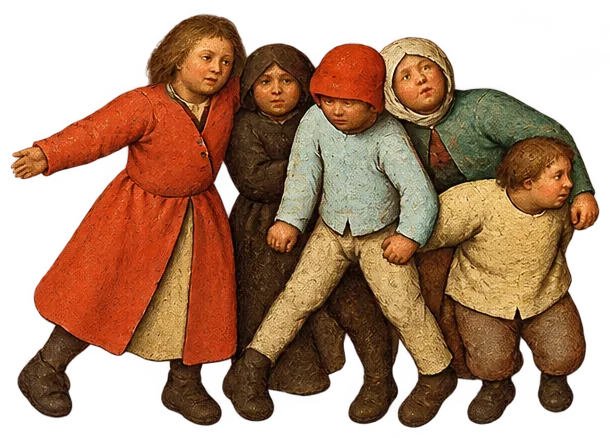
The figures on this site come from Children’s Games (1560) by Pieter Bruegel the Elder.